
St. Cloud State University Professors Dr. Jennifer Lamb and co-author Dr. Matthew Davis authored a publication that has been awarded Best Paper in Herpetology from the international journal Ichthyology and Herpetology.
Their 2025 publication, “Illuminating the Early Life of Salamanders: Exploring Biofluorescence During Development,” expands upon their groundbreaking 2020 study that first explored biofluorescence in salamanders and other amphibians.
The paper was also co-authored by SCSU alumnus Alexander Seymour, Dr. Lynne Beaty, an associate professor of biology at Penn State Behrend, and her undergraduate student Holden Cooper.
Biofluorescence is a natural phenomenon in which high energy light absorbed by an organism is emitted into the environment at lower energy wavelengths. This “glowing” effect had previously been explored more widely in the study of fish (ichthyology), but research into its presence and function in amphibians and reptiles (herpetology) is still in early stages.
“This paper continues to open up a lot of lines of questions into biofluorescence and amphibians, and it focuses on asking questions about parts of the life history of amphibians, the larval stages and embryos, that aren’t given a lot of attention,” Lamb said.
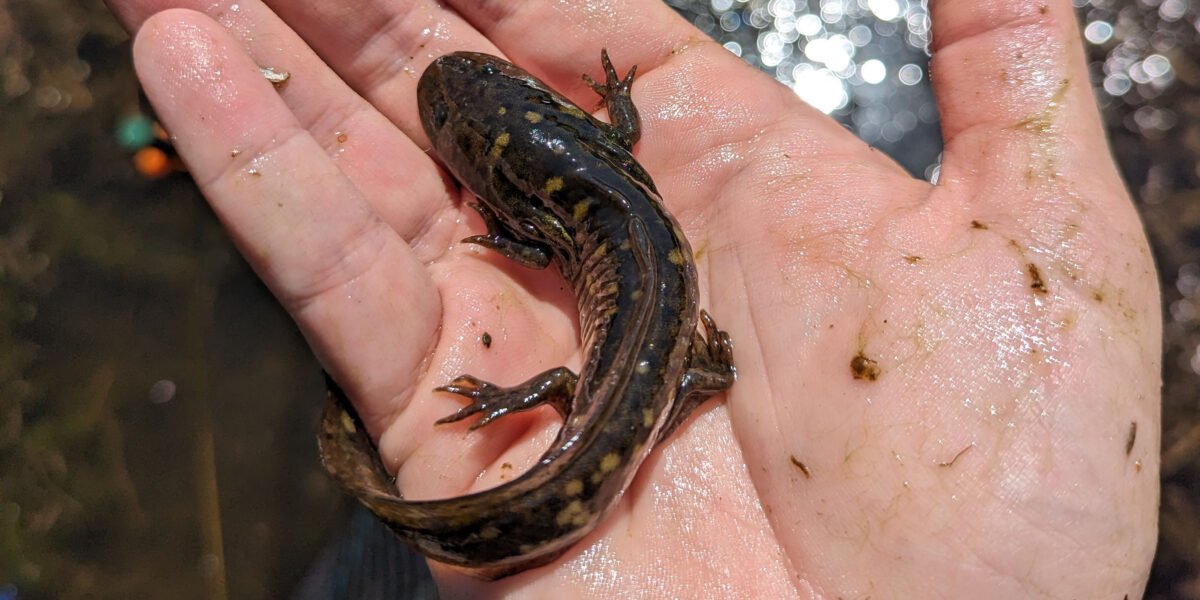
Their 2020 study focused on terrestrial or adult amphibians and only examined the juvenile, aquatic stages of a few species of amphibians. The new award-winning study is one of few to document and describe fluorescence in the eggs, embryos, and larvae of salamanders. These life stages experience very different environments from their terrestrial counterparts, which could result in the evolution of different patterns and functions of fluorescence.
The study observed bright fluorescence on the bellies of larval salamanders, which they hypothesize could be used to help them avoid detection in the water. Salamander eggs and embryos also fluoresced. The light fluoresced from the eggs was like that emitted by the plants they were laid in, which may help camouflage these vulnerable stages from predators.
“This new study opened up multiple potential directions for exploration that I hope to pursue with more students,” Lamb said. “Our work in biofluorescence has drawn graduate and undergraduate students into our labs. It has really sparked a lot of research not only here at St. Cloud State, but at other universities across the globe.”
Davis accepted the award on the team’s behalf at the Joint Meeting of Ichthyologists and Herpetologists in New Orleans in July.
Lamb and Davis were thrilled to be acknowledged by a prominent society journal like Ichthyology and Herpetology, which has been published for over 100 years.
“It’s always an honor to be recognized by a scientific society,” Davis said. “We dedicate a portion of our lives to study this type of biodiversity. It’s always great to see that a study is making a positive contribution, and that our research conducted at St. Cloud is having an impact across the field.”