


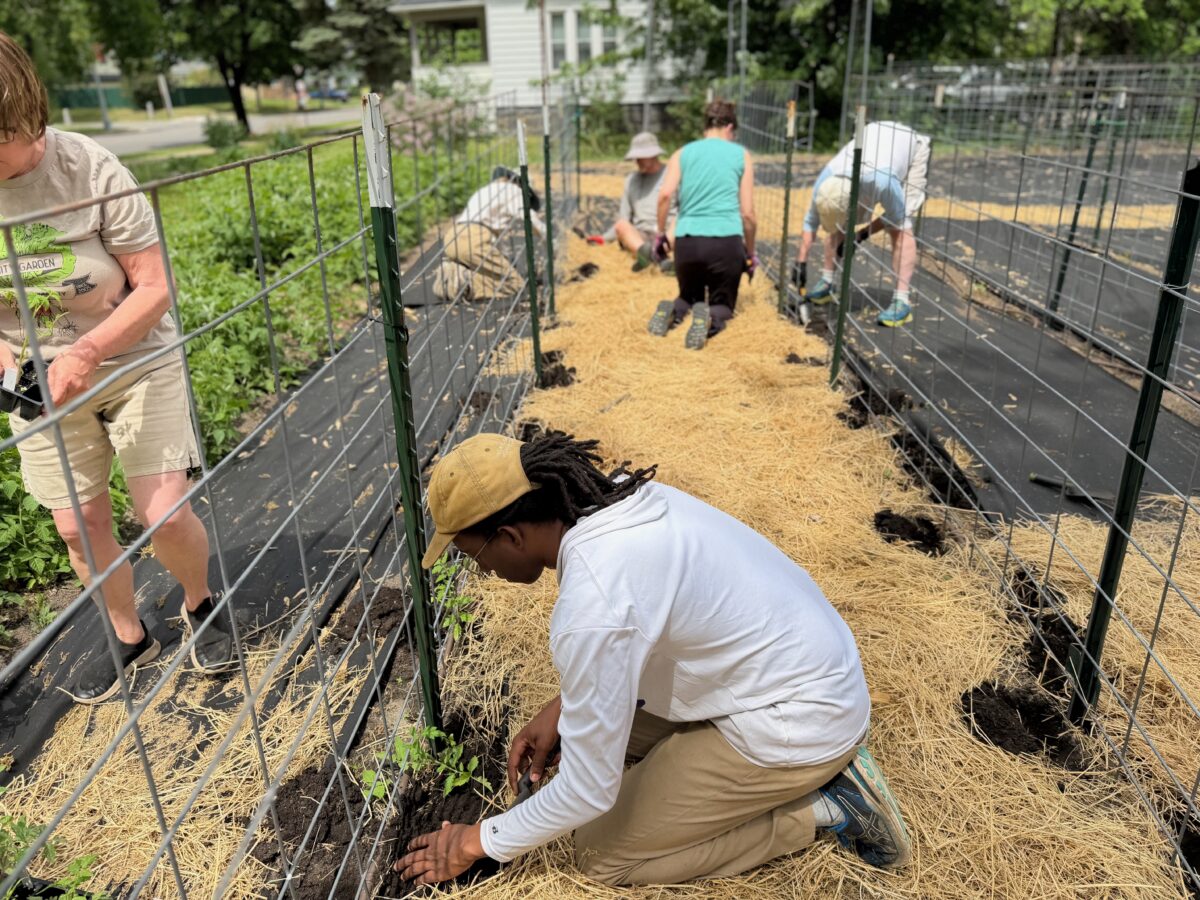
Every spring, the St. Cloud State University Community Garden waits for the soil to warm before planting its tomatoes. This year, the wait carries an added significance: in June, the garden will put the Husky Tomato in the ground for the first time. The non-GMO variety has been developed through years of collaboration between the garden and SCSU’s Department of Biology. Now, it’s being put to the test in its first outdoor field trial.
Tracy Ore, SCSU professor of sociology and director of the SCSU Community Garden, has wanted to grow a Husky tomato for over a decade, but it didn’t become a reality until Dr. Angela McDonnell joined the SCSU biology department in 2022. The idea for the Husky tomato is rooted in the garden’s long commitment to food sovereignty and community-centered growing.
Dr. McDonnell, both the director of the SCSU Biology Greenhouse and the SCSU Herbarium, was teaching her first plant biology class at SCSU when students requested to get involved in research. She turned to Ore for ideas, and the red and black striped tomato took seed.
“Dr. McDonnell took an idea and turned it into science — rigorous, patient, student-centered science. I brought her the vision; she had a plan. Watching her bring students into that work at every stage has been one of the genuine privileges of this collaboration, and the Husky Tomato is a testament to what becomes possible when a university and its community grow something together,” Ore said.
While the process of creating the Husky tomato is more time intensive than financially intensive, Dr. McDonnell said, the Husky Tomato Project is supported in part by the “Growing Community: Seeds to Summit” initiative. The three-year grant from the SCSU Foundation’s Husky Impact Funds connects the garden to the Honors College, Huskies Food Pantry, University Library, and SCSU Herbarium & Greenhouses.
Dr. McDonnell and her students got the first four seed lots to start the project from Ore: one seed lot of black heirloom tomatoes and three seed lots of red striped heirloom tomatoes. She took the students through the process of creating a hybrid tomato – from choosing parent plants and preventing self-pollination to collecting pollen, pollinating the mother plant, and harvesting the plant to collect its seeds. This process of cross-pollination was repeated hundreds of times – each involving meticulous data collection. Among other important data, students recorded whether the plant made fruit, and if so, the size, weight, color, and pattern of the fruit.
“Plants we have right now that we’ll grow in field trials are the result of four generations of crossing. Some of them have six or more different parents in their variety. The ones [seeds] we selected to move forward are the ones that are most promising and interesting for what will become the Husky Tomato. It’s still not one thing right now,” Dr. McDonnell explained.
The field trial is a culmination of work that has already earned recognition beyond St. Cloud: SCSU students AnnElise Swanson, Kendall Cross, and Sam Hennemann presented findings from the Husky Tomato Project at the Botany 2025 conference in Palm Springs, California — bringing student-led, community-rooted plant science to a national stage.
But now, that patient, careful field work of developing and hand-selecting the variety will move outside. Growing seeds in a greenhouse versus outside is a very different process, Dr. McDonnell explained. While the greenhouse is a controlled process, growing outside introduces pests, pollinators, different soil nutrients, and a different watering schedule.
Once Dr. McDonnell and her students selected the seeds to plant, Ore was in charge of making sure they developed into seedlings. Of the 48 Husky Tomato seeds planted, there was a 100% germination rate. Ore has become somewhat of an expert at growing tomatoes – among other fruits and veggies. Some of those 48 plants are about to go in the ground, but don’t get it twisted: The results aren’t for eating.
“This is important data collection,” Dr. McDonnell said. “We don’t eat our research.”
The resulting seeds from the fruit that grows this summer will be planted in the greenhouse to reproduce on their own to make a plant variety that is genetically stable.
For more information about the Husky Tomato Project, Community Garden Season 22 programming, or volunteer opportunities, contact Tracy Ore at [email protected] or visit stcloudstate.edu/communitygarden.