


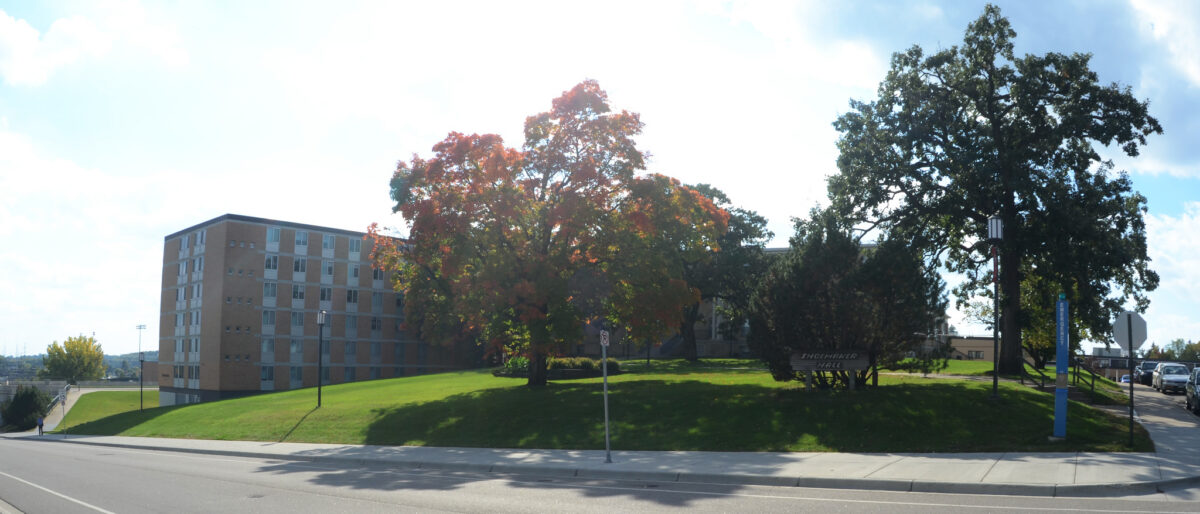
This time of year, St. Cloud State University pops up in the news with spooky ghost stories and haunted halls. A quick Google search brings up dozens of hits, with stories about hauntings on and around campus, from lights that flicker and moving furniture to doors opening on their own.
But for professors Dr. Steven McCullar, Dr. James Pickle and Dr. Rachel Friedensen, spooky isn’t a season: It’s something they think about year-round.
They recently contributed content for the book, “Myths, Mysteries, and the Macabre on American Campuses,” released on September 17 of this year. Edited by Christopher J. Broadhurst and Gordon W. Maples, “Myths, Mysteries, and the Macabre on American Campuses” is a collection of spooky campus stories and legends from across the country. The tales detailed in the chapters dictate stories that have become embedded in campus culture, so much so that mere 100-word ghost stories have become the things of lore passed down from student to student for centuries.
In addition to a story about the infamous Pepe of SCSU, the book features stories from Baylor University, Clemson University, University of South Carolina, St. Louis University, University of Louisiana at Lafayette, University of Kentucky, Brenau University, Bryn Mawr College, Mount Holyoke College, Western Carolina University, Ohio University and University of Alabama. Each chapter offers a retelling of the ghost story followed by an investigation into how the story reinforces campus culture.
Dr. McCullar, Dr. Pickle and Dr. Friedensen got involved with the book when a call went out on a higher education list for ghost stories on college campuses. Dr. McCullar recalled how Dr. Pickle had been telling him about Pepe since he’d started teaching at SCSU, so they knew they had to contribute.
“I’m a cognitive scientist and I use ghost stories and supernatural accounts related to cognition on campus. My students were doing an activity related to critical thinking using a framework, and one selected this story [about Pepe]. So it wasn’t at random; it naturally emerged from my work as a professor here,” Dr. Pickle said.
Pepe, of course, is one of the many subjects of SCSU lore that’s been passed down over the years. The story goes that Pepe was at SCSU when it was known as the State Normal School at St. Cloud, around 1915. She formed a relationship with a janitor and became pregnant. When he didn’t want to marry her, and for fear of judgement from the community, she died by suicide in the basement of Shoemaker Hall – a dorm that is still occupied today. To this day, there’s an altar to her in the basement of Shoemaker. Students report odd activity in the area, like stereos randomly turning up or down, a ghostly female figure or objects moving on their own.
Dr. Friedensen got involved with the book project because she’s known Christopher Broadhurst for a few years, and she enjoys his work. Her story isn’t about SCSU, but instead her alma mater Bryn Mawr College, a private women’s liberal arts college in Pennsylvania. She lived across the hall from the Bryn Mawr ghost, Lillian. A friendly ghost, the story of Lillian takes us back to the early 1900s. As Dr. Friedensen remembers it, Lillian was a bit of a hypochondriac. Fearing she had leprosy and not wanting to infect her family, she stayed in her dorm over a break and took a kerosene bath (a popular remedy at the time). The lantern fell into her bath, and she caught on fire. To put out the fire, she jumped out the window of the third story into a snowbank. She died on the way to the hospital. Now, she haunts the third floor of Merion Hall, messing with technology and turning lights off.
Dr. Friedensen’s chapter is co-authored with Dr. Carrie Kortegast, who tells a story of the Woman in White (or Wilder Ghost) at Mount Holyoke College, similar to Pepe’s story at SCSU. Their chapter focuses on ghosts at women’s colleges.
“I have known her [Dr. Kortegast] a long time and said yes, I’d absolutely collaborate. It was mostly kind of a love letter to my college and the most fun thing I’ve ever written,” Dr. Friedensen said.
The room the Woman in White ghost is said to occupy is still intact at Mount Holyoke College. When housing became an issue some years ago, the college decided to open up the boarded room. When students pushed back, the president of the college said she’d stay there to prove the room wasn’t haunted. She lasted a mere three hours one night before declaring the room should be permanently boarded up.
Each professor’s research relied on archives and conversations with alumni and current students. But so much of the stories they’re telling are deeply embedded in folklore: a group of stories believed by a group of people – in this case the communities at universities and colleges – and passed down from generation to generation.
There is no record of Pepe ever existing on campus according to the archives, but myth tells a deeper story and guides campus behavior. Were these merely stories designed by the colleges to warn students of unseemly behavior and to keep them out of forbidden campus areas, or are they something supernatural?
“Whether true or not, it doesn’t matter,” said Dr. Pickle. “For an archivist, everything is printed record. If not, it doesn’t exist. And in folklore that isn’t the case. You look for elements that make the story plausible rather than a specific record that may or may not have been manipulated.”
Readers will have to decide for themselves if the stories are mere folklore, cautionary tales about college life or true ghost stories.
“Carrie and I discussed how it didn’t matter if they’re real or a ghost or not. It doesn’t matter because we behaved as if Lillian was real. Weird stuff would happen and it would be like, ‘Haha, it’s Lillian.’ It’s funny and goofy but a little bit of a bonding thing that brought us together as students, and it’s a touchstone for students at Bryn Mawr,” Dr. Friedensen said.
Whatever they are, campus culture relies on their retellings; telling these stories reunites students with past lives that inhabited the campuses they now roam. Myths have a binding effect and help forge a connection with the past.
“These stories find a way. I’ve heard them for 15 years, and students heard them in the 1950s. They go back. There’s beauty in that,” Dr.McCullar said. “This is a love letter to St. Cloud State.”
For those interested in a copy of “Myths, Mysteries, and the Macabre on American Campuses,” copies can be purchased on Amazon.